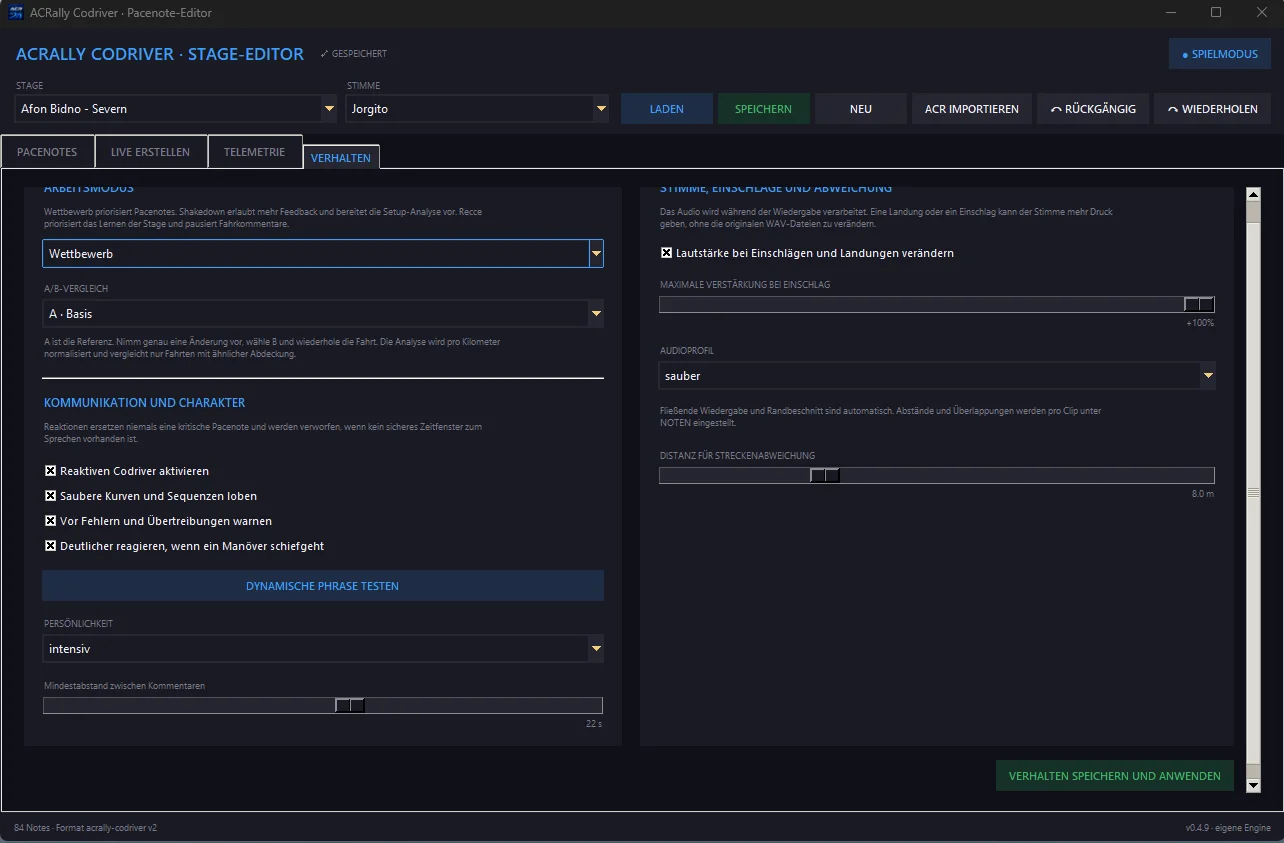
Hola! Durante el último mes estuve trabajando en una versión de motor que se desprende completamente de lo que ya conocíamos de la aplicación PacenotePal, la cual sirvió en su momento como punto de partida (Gracias!!) pero que me generaba limitaciones a la hora de incluir las mejoras que se me ocurrían y que otros también me iban sugiriendo.
Así que después de varios testeos, de incanzables horas probando y corrigiendo, llegué a concretar una base bastante sólida con la cual ahora podemos sentir que tenemos una persona hablando y no un sistema reproduciendo archivos de audio. (Sobre todo si podemos generar voces naturales)
Así que tal transformación amerita un nuevo nombre y es:
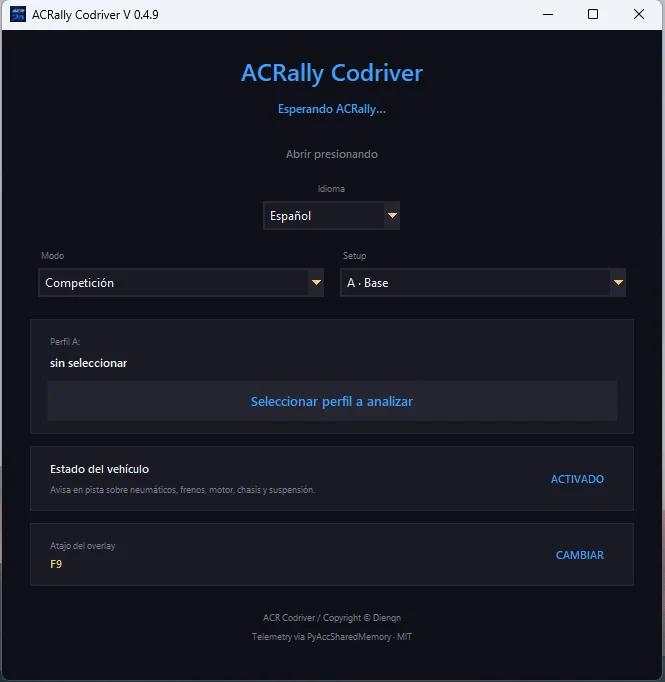
ACRally Codriver v0.4.9
Copiloto inteligente y editor de tramos para Assetto Corsa Rally.
ACRally Codriver utiliza un motor propio organizado en el paquete `codriver/`,
un overlay modular, análisis de telemetría y un editor de etapas independiente.
Mantiene los tokens técnicos de voz de Assetto Corsa Rally, pero las etapas se
guardan únicamente en el formato nativo `stages_v2`. El runtime no necesita un
mapa externo de nombres ni una segunda copia simplificada de las pacenotes.
## Qué incorpora
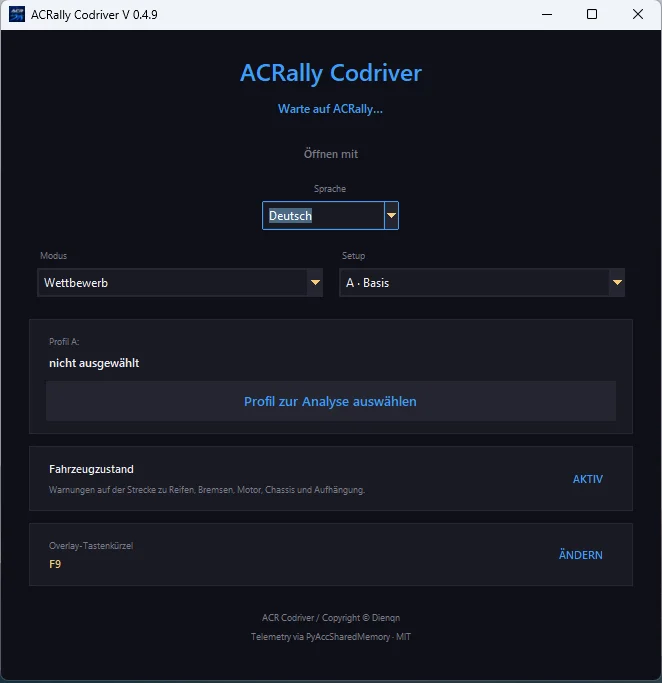
– Monitor conmutable del estado del vehículo: lee presión, temperatura y
desgaste de neumáticos, temperatura/vida de frenos, temperatura de motor,
daños de chasis y suspensión. Los avisos respetan la prioridad de las
pacenotes y quedan registrados en el informe final. Si ACR no publica un
canal, la aplicación no inventa un porcentaje.
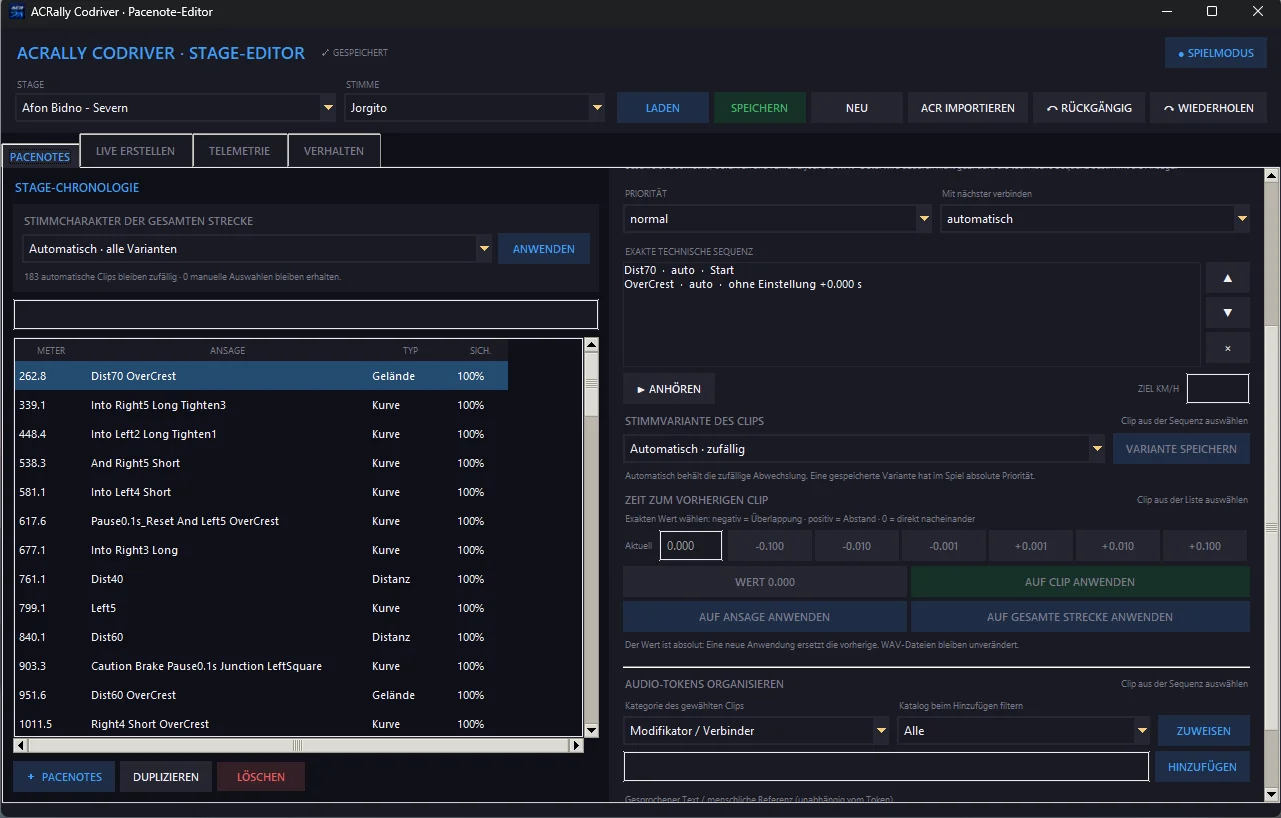
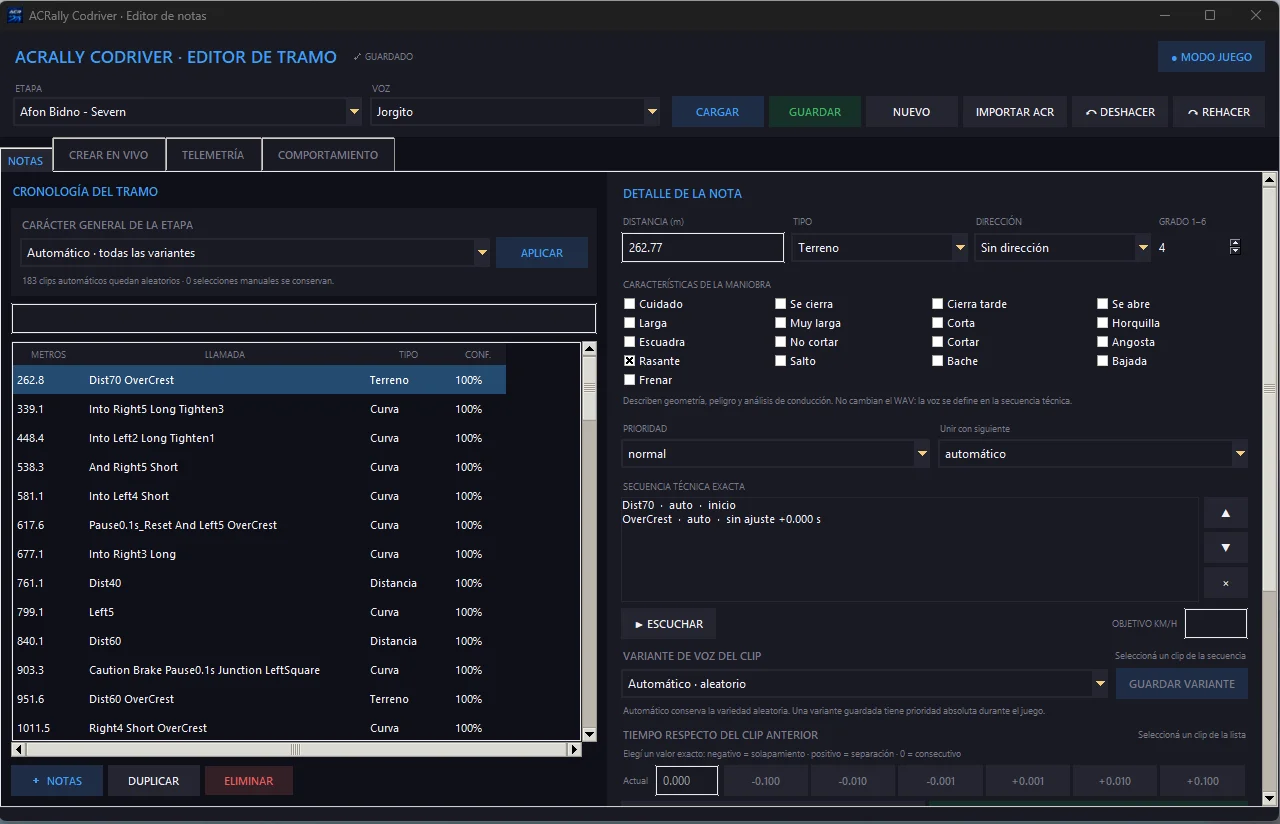
– Editor minimalista por cronología: miles de notas ya no crean miles de
controles de interfaz.
– Inspector semántico para tipo de elemento, dirección, grado, modificadores,
prioridad, unión, recordatorio y evaluación.
– Separación real entre token técnico, etiqueta visible y texto hablado.
– Creación en vivo por odómetro con botones rápidos de curvas, peligros y
terreno.
– Pasada de reconocimiento que propone curvas, dirección, radio, grado,
longitud, apertura/cierre, rasantes, saltos y baches.
– Línea de referencia aprendida para detectar una salida del recorrido por
posición mundial.
– Detección reactiva de golpes, aterrizajes, auto cruzado, trompos, despiste y
recuperación mediante varias señales de SharedMemory.
– Evaluación de cada curva: confirma giro, dirección, deslizamiento, golpes y
desvío antes de felicitar o corregir.
– Frases técnicas breves, con `Into` automático sólo para una transición
inmediata, duración real de todas las variantes WAV y anticipación por
velocidad. Una secuencia editada conserva todos sus clips, incluidos `And`
e `Into`.
– Recordatorios cercanos que repiten únicamente una instrucción decisiva
—por ejemplo `TightensLate`, `DontCut` o `HeavyBrake`— en vez de volver a
cantar toda la nota.
– Reacciones con memoria y enfriamiento: felicitaciones, correcciones, retos y
recuperación sin transformar al copiloto en un comentarista constante.
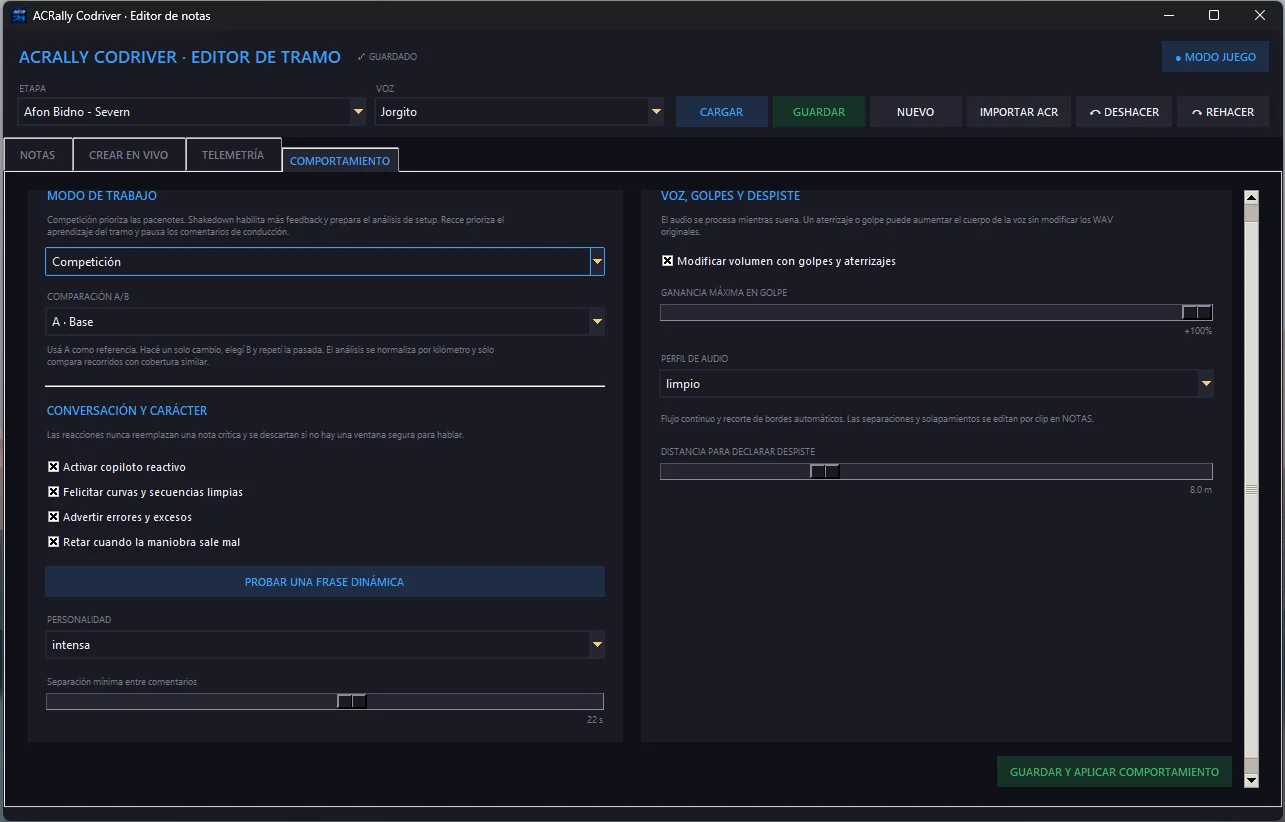
– Procesamiento de audio por bloques. Un golpe puede elevar progresivamente
la voz hasta `+100 %`, aplicar un temblor breve y limitar la señal sin
clipping digital.
– Flujo continuo de voz: recorta bordes desiguales, conserva ataques suaves y
entrega cada bloque como una sola frase sin cambiar los tokens guardados.
– Perfiles de audio `clean`, `modern_intercom` y `classic_intercom`.
– Guardado atómico, historial de deshacer/rehacer y copias de seguridad.
– Importador de DataTables oficiales `DT_Pacenote*`: detecta Steam y
exportaciones de FModel, recupera distancia, unión y tokens originales, y
carga todo para revisión antes de permitir guardarlo.
– Interfaz completa en español, inglés, francés, italiano, polaco y alemán;
el editor nuevo comparte el mismo sistema de traducciones que el overlay.
Dejé algunas guias en español, no realicé la traducción porque ya estoy agotado. Pero está bastante detallada.
Agradezco a @.Cyn que me ha dado varios consejos, y me ayudo a cerrar una idea que tenía, a la cual no le estaba pudiendo dar forma.
El sistema ya reconocía variantes de tokens, pero ahora los podemos seleccionar, si queremos un token normal “Left C_”, normal acelerado “Left C+”, con entonación interrogatoria “Left U_, Left U+” o enérgico “Left L_, Left L+” o simplemente los valores que ya trabajabamos “Left”.
Además del solapamiento inteligente de audios que el motor nuevo ya propone, se incorpora una selección manual de adelantamiento o retardo entre tokens, que puede ser aplicado de forma individual por tramo, o a toda la etapa.
Y bueno, el resto está para explorar!
Agregamos el idioma Aleman .
A partir de ahora la aplicación pasa a llamarse ACR Codriver, y esta es su versión 0.4.9
De nuevo muchas gracias @.Cyn!
Dienqn
_____________________
Hi! For the past month, I’ve been working on a version of the engine that’s completely separate from what we already knew from the PacenotePal application, which served as a starting point (Thanks!!) but which limited me when it came to including the improvements I came up with and that others suggested.
So, after several tests and countless hours of testing and debugging, I’ve managed to create a fairly solid foundation with which we can now feel like we have a person speaking and not a system playing audio files. (Especially if we can generate natural voices)
So, this transformation deserves a new name:
ACRally Codriver v0.4.9
Intelligent co-driver and stage editor for Assetto Corsa Rally.
ACRally Codriver uses its own engine organized in the `codriver/` package,
a modular overlay, telemetry analysis, and a standalone stage editor. It retains the voice-activated technical tokens from Assetto Corsa Rally, but stages are saved only in the native `stages_v2` format. The runtime does not require an external name map or a simplified second copy of the pacenotes.
## What’s Included
– Switchable vehicle status monitor: reads tire pressure, temperature, and wear, brake temperature/life, engine temperature, and chassis and suspension damage. Alerts respect pacenote priority and are recorded in the final report. If ACR does not publish a channel, the application does not fabricate a percentage.
– Minimalist timeline editor: thousands of notes no longer create thousands of interface controls.
– Semantic inspector for element type, direction, grade, modifiers, priority, join, reminder, and evaluation.
– True separation between technical token, visible label, and spoken text.
– Live odometer creation with quick buttons for corners, hazards, and terrain.
– Reconnaissance run that suggests curves, direction, radius, degree,
length, opening/closing, crests, jumps, and bumps.
– Learned reference line to detect course deviation by
world position.
– Reactive detection of impacts, landings, cross-tracking, spins, drifts, and
recovery using various SharedMemory signals.
– Evaluation of each curve: confirms turn, direction, slide, impacts, and
deviation before congratulating or correcting.
– Short technical phrases, with automatic `Into` only for an
immediate transition, actual duration of all WAV variants, and anticipation by
speed. An edited sequence retains all its clips, including `And` and `Into`.
– Nearby reminders that repeat only a critical instruction
—for example, `TightensLate`, `DontCut`, or `HeavyBrake`—instead of
singing the entire note again.
– Reactions with memory and cooldown: congratulations, corrections, challenges, and recovery without turning the co-pilot into a constant commentator.
– Block audio processing. A hit can progressively raise the voice level by up to +100%, apply a brief jitter, and limit the signal without digital clipping.
– Continuous voice stream: trims uneven edges, preserves smooth attacks, and delivers each block as a single phrase without changing saved tokens.
– Audio profiles: `clean`, `modern_intercom`, and `classic_intercom`.
– Atomic saving, undo/redo history, and backups.
– Importer of official `DT_Pacenote*` DataTables: detects Steam and FModel exports, recovers distance, join, and original tokens, and loads everything for review before allowing saving.
– Full interface in Spanish, English, French, Italian, Polish, and German; the new editor shares the same translation system as the overlay.
I left some guides in Spanish; I didn’t translate them because I’m exhausted. But they’re quite detailed.
I’m grateful to @.Cyn for giving me several tips and helping me finalize an idea I had that I couldn’t quite develop.
The system already recognized token variations, but now we can select them: a normal token (“Left C_”), a normal accelerated token (“Left C+”), a token with a questioning intonation (“Left U_, Left U+”), or an energetic token (“Left L_, Left L+”), or simply the values we were already using (“Left”).
In addition to the intelligent audio overlap that the new engine already offers, a manual selection of lead or delay between tokens has been added, which can be applied individually to each segment or to the entire stage.
And well, the rest is for you to explore!
We’ve added German.
From now on, the application will be called ACR Codriver, and this is version 0.4.9.
Thanks again, @.Cyn!
Dienqn
Downloads
| Name | Format | Size |
|---|---|---|
| ACRally-Codriver.zip | ZIP | 114.44 MB |
To start download click the filename. To open archive files use one of these programs: WinRAR, 7-Zip, WinZip. Some mod archives may need to be extracted before the mods will work.